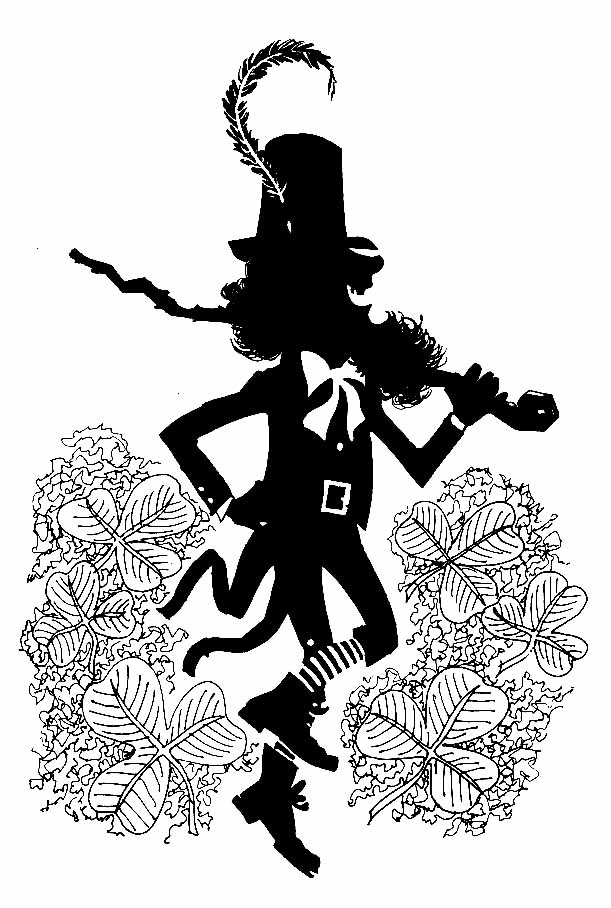
It is time the Irish reclaimed St. Patrick's Day as their own.
This site is a humorous response to all the erroneous nonsense that goes on throughout the American continent on 17th
March in the name of the good gentleman.
First of all it may surprise you to know that St. Patrick's Day was
not traditionally celebrated in Ireland in the same way it is in America and we most definitely did not drink green beer.
St. Patrick's Day was first and foremost a religious celebration
in the old country. The colour most often associated with St. Patrick was blue which was also the colour of the old Irish flag.
SHAM SHAMROCK
The Irish shamrock is a small leafed plant with THREE leaves, not four as commonly found on Canadian St.
Patrick's Day merchandise (made in China).
If you want to get botanically picky, the original used by St.
Patrick to explain the Holy Trinity was probably hop clover (trifolium minus), white clover (trifolium repens), wood
sorrel (oxalis acetosella) or the black medic (medicago lupulina) - not the huge leafed oxalis often sold in America -
remember the old Irish song is "The Dear Little Shamrock". The plant commonly sold nowadays at
Covent Garden as shamrock is trifolium minus, a small yellow-flowered clover, and the same plant is now used as shamrock
in Ireland in the counties of Antrim, Down, Meath, Fermanagh, Dublin, Wicklow, Carlow, Westmeath, Wexford, Limerick, Waterford,
Cork, and Kerry. This plant, in present usage, has the greatest claim to the name of true shamrock.
IS IT CLOVER?
The rare mutation of a four leafed clover was revered by pre Christian Druids
and is considered lucky if you are fortunate enough to find one. Nowadays Oxalis deppei (a plant which naturally has four
leaves) is used as a good luck plant. However it is not a true clover - just a lookalike. Perhaps when it is used on St. Patrick's
Day it is meant to symbolise the luck o' the Irish, but PLEASE don't call it a shamrock!
WHAT ON EARTH IS CORNED BEEF?
As for corned beef - well...the Irish never ate the
stuff. Now, it has been pointed out to me that James Joyce mentions it in The Dubliners. That may be so, but Dublin
city has always been culturally more English than Irish. Beef was corned in and around the Cork region of Ireland from
the late 1600s ( when the English took control) to the early 1800s but this was almost exclusively for
export to England and Europe and was not commonly eaten by the natives. In my experience most people in Ireland agree
that corned beef first appeared in cans during the War and to my knowledge that is the only way it is still available there.
(But the Americans ARE right about the cabbage!)
Just so you won't forget, here is a little poem!